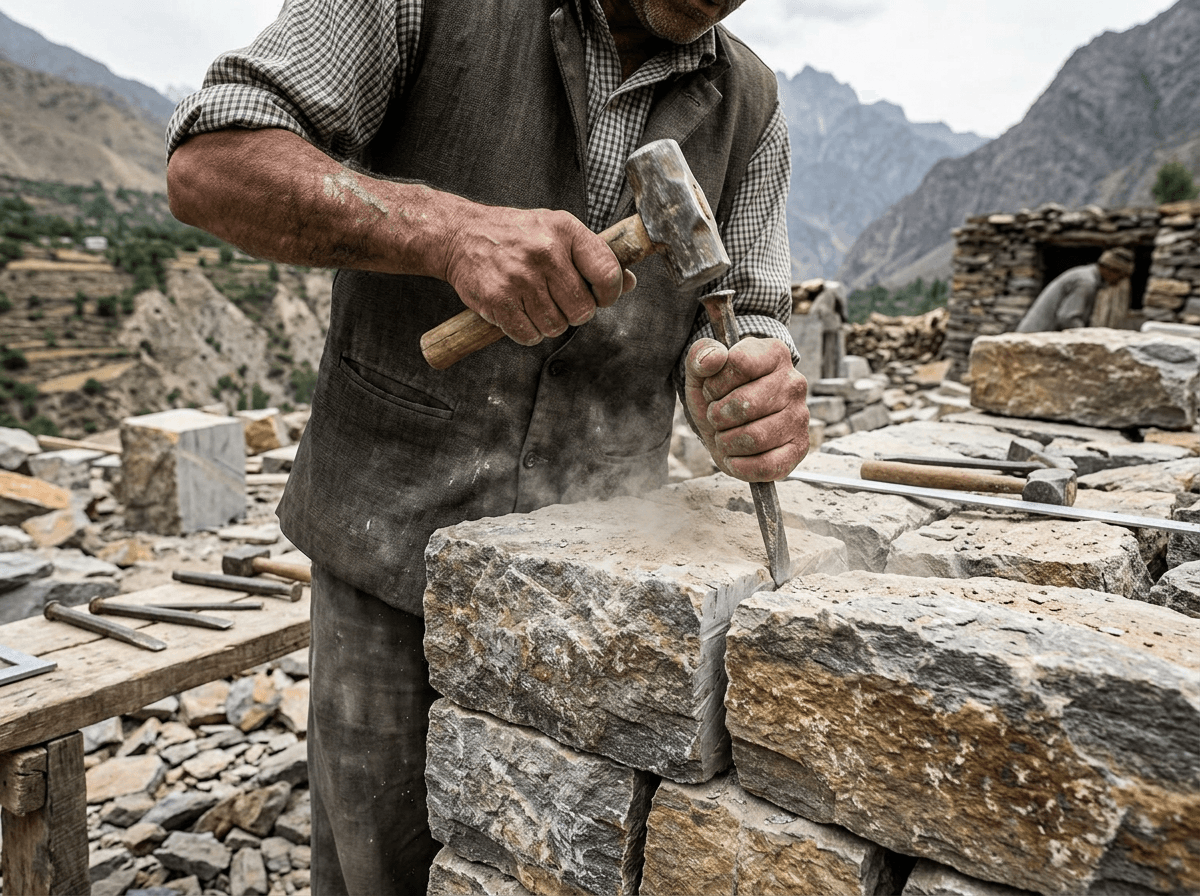
Limestone and sandstone quarried within the valley behave differently, weather differently, and connect a new residence to the region in a way imported cladding never will.
Kashmir has building stone in abundance — limestone and sandstone from quarries across the valley have been the region's default construction material for as long as anyone's been building here permanently. Working with local stone, rather than importing tile or cladding from elsewhere in the country, is partly a material-quality decision and partly a design one: stone quarried and cut close to a site tends to weather the way the region's older buildings already have, which is a kind of visual honesty a shipped-in substitute rarely achieves.
The limestone found around Srinagar and the sandstone from quarries further into the valley have genuinely different working properties — different hardness, different porosity, different response to the valley's freeze-thaw winters. Sandstone tends to be easier to carve into detail work (door surrounds, decorative banding) but needs a more considered approach to sealing against water absorption; limestone is denser and more weather-resistant in its raw state but less forgiving to carve finely. Specifying the right stone for the right application — structural walling versus decorative facing versus flooring — is a judgment call we make on every project, not a single default answer.
Sourcing from quarries within the valley, rather than trucking in stone from outside the region, keeps a project's embodied transport carbon down and keeps money inside the local economy that still depends on quarrying and stone-working trades. It also means the stone we're specifying has already been proven, over generations of local buildings, to perform in exactly this climate — freeze-thaw cycling, monsoon-adjacent humidity swings, direct high-altitude sun — rather than relying on a spec sheet written for a different climate zone entirely.
Good stonework depends as much on the mason's hand as the stone itself — coursing pattern, joint width, how a corner is turned, how a lintel is bedded. We work directly with local stone-masons on detailing decisions rather than handing over a drawing set and expecting it executed literally; the best results on past projects have come from conversations on site about what a particular stone wants to do, not just what a drawing says it should do.
There's a simpler case for all of this too: stone, worked well, is what a serious residence in this valley has always looked and felt like. Cladding a new house in imported material that has no relationship to the region isn't a neutral choice — it's a choice to disconnect the building from the place it sits in. Working in local stone, sourced and cut close to home, keeps a new house legible as a Kashmiri building, not a generic one that happens to be located here.