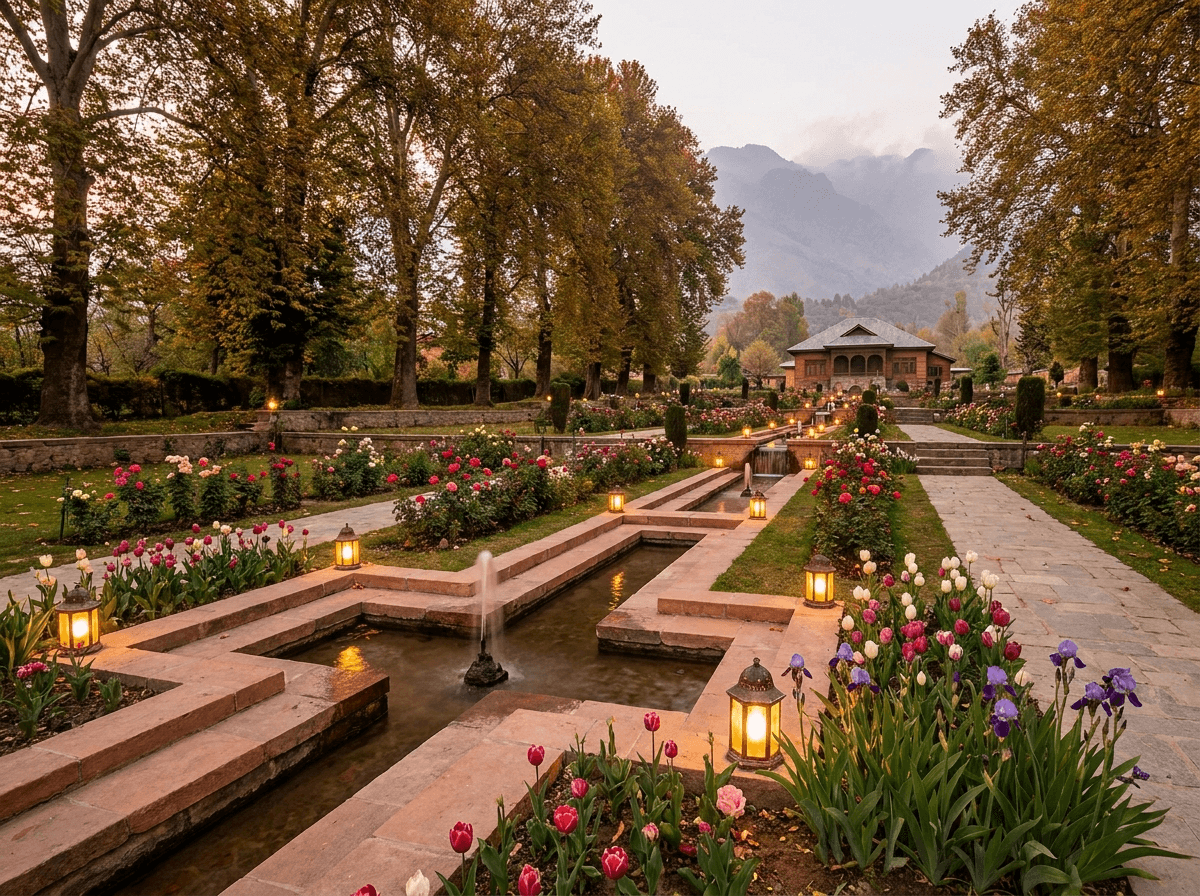
Shalimar and Nishat Bagh organize an entire landscape around one axis, terraced water, and a restrained planting palette — a vocabulary that still translates well to a modest residential garden.
Srinagar's Mughal gardens — Shalimar Bagh, Nishat Bagh, Chashme Shahi — are among the most studied historic landscapes in South Asia, and for good reason: they're a masterclass in using terraced levels, water, and axial geometry to organize a garden around a single unifying idea rather than a scatter of planting beds. We draw on that vocabulary regularly in residential landscape design, not by literally replicating a Mughal garden at house scale, but by borrowing its underlying logic.
Every Mughal garden in the valley is built around a strong central water channel running the full length of the site, terraced down a slope in a series of stepped levels, with the architecture and planting arranged symmetrically along that spine. At residential scale, we rarely have room for a literal chadar waterfall and channel system, but the principle — a single clear axis that the landscape organizes around, rather than a lawn with plantings arranged incidentally — translates well even to a modest garden, giving a small space a sense of intention it wouldn't otherwise have.
Water in a Mughal garden isn't ornamental in the way a modern decorative fountain often is — it's functional: it cools the air passing over it, it reflects the sky and architecture to visually double a space, and its sound masks street noise in a way that reads as deliberate rather than accidental. On residential sites where budget and space allow, we look for a genuine (if modest) water element positioned to do the same three jobs — cooling, reflection, acoustic softening — rather than a decorative feature that only does the last of those, poorly.
Much of the land around Srinagar isn't flat, and a Mughal garden's answer to a sloped site — work with the grade in a series of level terraces rather than cutting and filling it flat — is often the more sensible and more beautiful approach for a residential garden too. Terracing also naturally organizes a garden into a sequence of distinct outdoor rooms (an entry terrace, a dining terrace, a quieter upper terrace) rather than one undifferentiated lawn, which suits how families actually use outdoor space over the course of a day.
One thing that surprises people about the historic gardens is how restrained the planting palette actually is — chinar trees for structure and autumn color, cypress for vertical rhythm, seasonal flowering beds used sparingly rather than everywhere. We follow the same restraint in residential planting plans: a small number of well-chosen, climate-appropriate species repeated with intention reads as considered; a large mixed palette, however well-intentioned, tends to read as decoration rather than design.