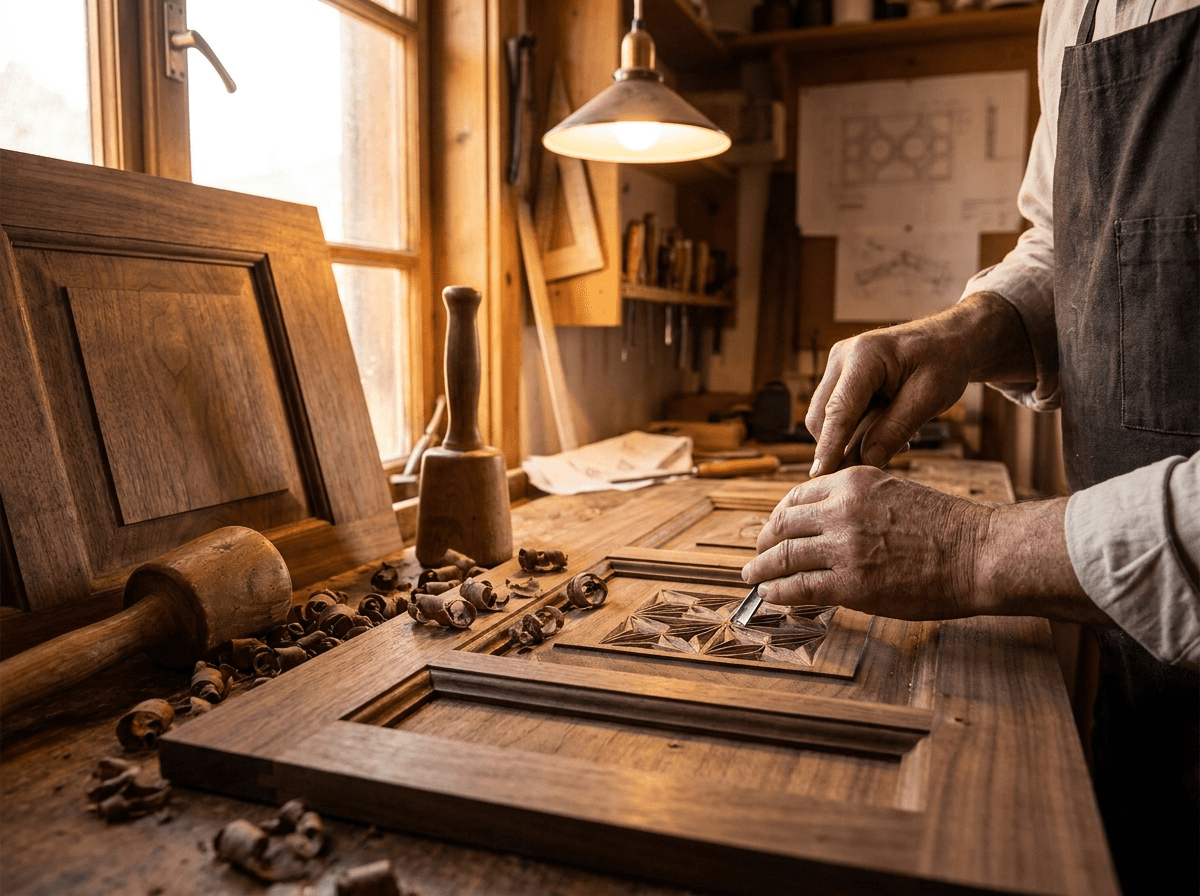
Khatamband lattice ceilings and carved walnut screens are a centuries-old Kashmiri craft tradition — and, coordinated correctly, a genuine fit for contemporary residential design.
Walk through the old quarters of Srinagar and the ceilings tell a story the walls don't. Look up in a well-preserved Kashmiri interior and you'll often find khatamband — a geometric lattice ceiling built entirely from small interlocking pieces of walnut or deodar, assembled without a single nail or drop of glue. It's a craft that takes years to learn properly, and one that nearly disappeared from new residential construction as faster, cheaper false ceilings took over. We think it belongs back in the conversation — not as a museum piece, but as a real material choice for contemporary homes.
Khatamband work starts with hundreds, sometimes thousands, of small geometric panels — squares, polygons, stars — cut individually and slotted together into a rigid interlocking grid, traditionally suspended a short distance below the structural ceiling. The technique dates back centuries in Kashmir, closely tied to the region's Persian-influenced craft traditions, and the same jointing logic that holds the panels together without fasteners is what gives a finished khatamband ceiling its ability to be dismantled and reassembled — a practical advantage in a region with a real seismic history. A skilled khatamband craftsperson can read a room's proportions and lay out a pattern that makes a modest-sized room feel considerably taller and more resolved than a flat plaster ceiling ever could.
The same walnut wood tradition that produces khatamband panels also produces Kashmir's carved wood panelling, screens, and furniture — deep relief carving in floral and chinar-leaf motifs that's been a regional signature for centuries. Walnut is prized here for good reason: it's dense, tight-grained, resistant to the region's humidity swings, and it darkens beautifully with age rather than degrading. In residential work, we use carved walnut screens as room dividers and stair balustrades, and as door and window surrounds where a flat modern opening would otherwise read as sterile against everything else in the room.
The honest challenge with reviving khatamband and carved walnut work isn't the craft itself — Srinagar and the surrounding villages still have genuinely skilled artisans capable of extraordinary work. It's integration: a lattice ceiling and a heavily carved screen were designed for a different structural and mechanical context than a contemporary home with recessed lighting, HVAC ducting, and drywall partitions. We coordinate khatamband layout with the electrician and the HVAC contractor before a single panel is cut, so the geometric pattern isn't interrupted by a light fixture nobody planned for, and we treat these elements as a design decision made at the same table as the floor plan — not a finishing touch bolted on at the end.
Every khatamband ceiling and carved screen in one of our projects comes out of a direct relationship with the artisans who make it, not a catalogue order. That means longer lead times and real conversations about pattern, proportion, and what a given room can support — and it means every finished piece is genuinely one of a kind, made by hands that have done this work for decades. In a market full of imported laminate finishes, that's not a nostalgia play. It's simply better material, made by the people who still know how to make it, and it belongs in the homes we're building today, not just the ones we're restoring.