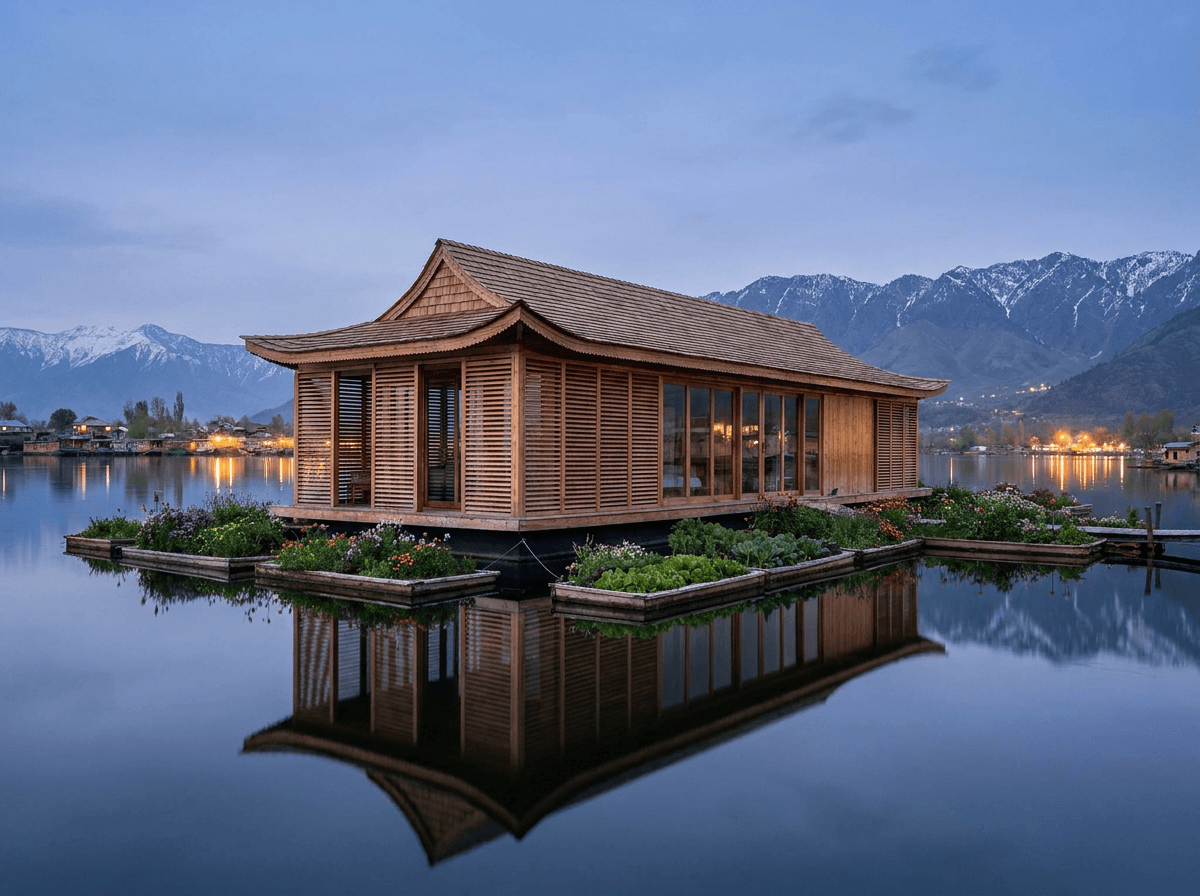
Dal Lake's carved-walnut houseboats deserve better than a choice between frozen heritage piece and disposable tourist product — adaptive reuse keeps the hull and craft, upgrades everything else.
Dal Lake's houseboats are one of Kashmir's most recognizable residential typologies, and also one of its most misunderstood from a design standpoint — often treated as a fixed heritage form to be preserved unchanged, or dismissed as tourist infrastructure rather than genuine residential architecture. We think there's a more interesting position between those two: the houseboat as a typology worth adapting seriously for contemporary residential and hospitality use, not freezing in place or discarding.
The classic Kashmiri houseboat — carved walnut interior paneling, a long shallow-draft timber hull, a covered veranda running the boat's length — solved a genuinely hard brief: a comfortable, richly detailed residence that floats, is built almost entirely from timber, and has to perform in a climate with real seasonal temperature swings and a humid lake environment working against the wood constantly. The deep verandas and generous window bands were climate responses as much as aesthetic ones, drawing cross-breeze through the long, narrow plan in a way a conventional house layout doesn't need to.
A number of existing houseboats on Dal Lake are structurally sound in their hull and frame but dated or deteriorated in their fit-out — this is where adaptive reuse, rather than replacement, makes sense. Retaining a serviceable hull and structural frame while reworking insulation, plumbing, and electrical systems to a modern standard is both the more sustainable path (a houseboat hull represents an enormous quantity of increasingly scarce old-growth deodar) and often the only realistic one, given how disruptive a full rebuild is on a floating structure moored in an active lake.
On adaptive-reuse and new-build houseboat work alike, we hold to the same material and craft language the traditional form established — carved walnut paneling, timber construction throughout, generous glazing along the veranda — while quietly upgrading what sits behind it: proper insulation in the hull and roof (largely absent in older boats), improved waste and water systems suited to the lake's ecological sensitivity, and structural surveys of the hull that a boat built decades ago never had at the time.
A houseboat done well is still one of the most direct expressions of Kashmiri craft and climate response available anywhere in the region's residential architecture — carved timber, water-adjacent living, a plan shaped entirely by its site. Treating it as a living typology worth real design attention, rather than a fixed heritage artifact or a purely commercial tourist product, is how we think it earns its place in the region's architecture for another generation rather than slowly becoming a museum piece.